
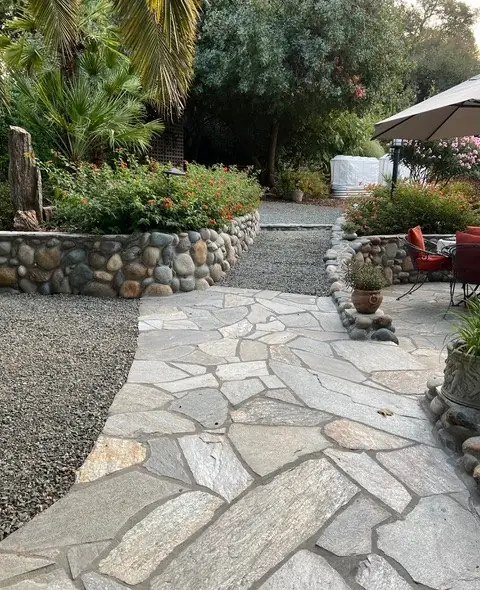
The base under your flagstone matters as much as the stone on top. Before you pick a stone, decide whether it will be mortared in place for good or set loose on a permeable base. Each approach has real strengths. The choice affects which thickness you buy, how you clean the patio, how water drains, and whether moss can grow between the stones. This guide lays out the differences so you can decide with confidence.
Hard-set: mortar over concrete
A hard-set installation bonds the flagstone to a concrete slab with mortar, and the joints are filled with mortar or grout. The result is permanent and solid. Thinner stone, such as 1 1/4 inch Select and veneer, should be hard set this way.
Hard-set surfaces are easy to sweep and can be cleaned with a hose more aggressively. They suit large patios, pool decks and high-traffic entries. We carry mortar, cement, bonders and Davis color to tint mortar joints. See our supplies.
A hard-set job depends on the slab underneath. Cracks in the concrete can show through the stone over time, so start with sound concrete. Plan joints and drainage before the mortar goes down, because a mortared surface is hard to change later.
Soft-set: a permeable base
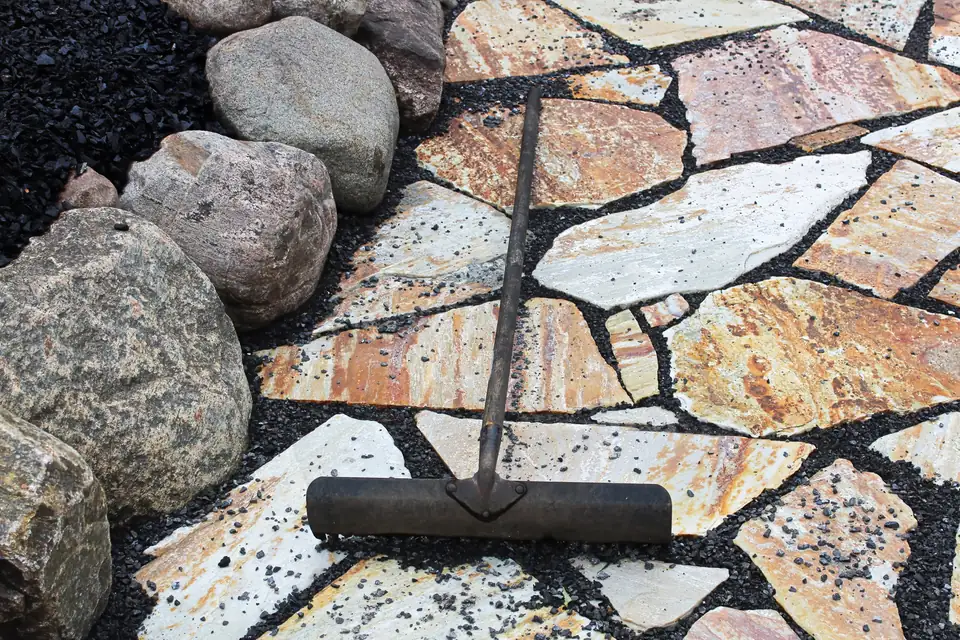
A soft-set installation lays thicker flagstone, 1 1/2 to 2 inches, on a compacted base. Sand and decomposed granite fill the joints. Water soaks through the joints instead of running off.
The general approach is well established: excavate, lay and compact a gravel base, add a leveling layer, set the stones, then sweep in joint material. Slope the surface slightly away from the house so water drains. Joint products like Gator Dust help hold the joints together. See Gator Dust installation.
Soft-set work is forgiving and approachable for many do-it-yourselfers. The key is compaction. A base that is compacted in thin layers stays flat much longer than one that is dumped and raked. Our sister company, Roundtree Rock & Gardening, sells gravel, sand and decomposed granite in the same yard.
Cleaning, moss and joints
- Cleaning: a high-pressure hose cannot be used on sand or decomposed granite joints. It will wash the filler out. Plan on sweeping and gentle rinsing for soft-set.
- Moss: if you want moss or low plants growing between the stones, you need a soft base.
- Permanence: a mortared surface is fixed. A soft-set surface can be lifted and reset if a stone settles.
Wider joints: save stone, watch the heels
On soft-set walkways and patios you can space the stones further apart and use more decomposed granite between them. That uses less stone. Before you decide, think about foot traffic. If guests in high heels will walk on your flagstone, heels can slip into the joints and cause a fall or a ruined shoe. Tighter joints are safer for entertaining areas.
Which is right for you?
Choose hard-set if you have a slab, want a permanent surface, or plan to pressure-wash. Choose soft-set for a permeable, natural look, planted joints, or a path through the garden. Tell our staff which way you are leaning, and we will match the stone thickness to the base. Read the flagstone thickness guide next.
Some projects use both. A mortared patio next to the house can flow into a soft-set path through the garden. Ask us how to handle the transition between the two.