
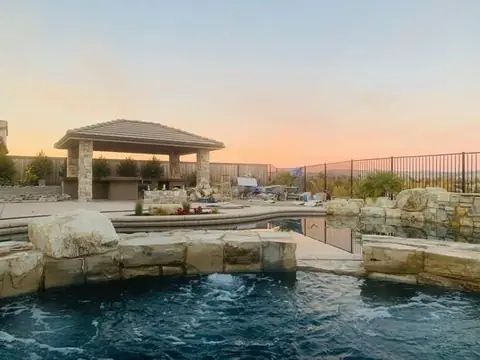
Ponds, streams, waterfalls, fountains and pool edges are some of the most rewarding places to use natural stone. They are also the hardest on it. Stone around water stays wet, may sit in treated pool water, and can grow algae or show mineral deposits. The right stone looks better every year. The wrong one can wear or discolor. This guide covers what to tell us, which kinds of stone work where, and how to plan the job.
Tell us exactly how the stone will be used
Some stone does not react well to chemicals in water, or to constant exposure to water. That is why the most important thing you can do is tell our staff the plan. Is the stone in the water, at the edge, or near it? Is it a chlorinated pool, a saltwater pool, a fish pond or a fountain? We will guide your selection to a stone that fits.
Ask about maintenance, too. Algae and mineral deposits show more on some stones than others. Light stone can show staining, while darker stone may hide it. Our staff can tell you how different stones tend to look after time in and around water.
Stone types that work around water
If you already have a stone in mind, ask us about it by name. We will tell you honestly whether it is a good fit for your water feature.
- Boulders for waterfalls, pond edges and around pools. They range from about 6 to 8 inches up to 4 by 4 feet.
- Cobbles and pebbles for streambeds, pond bottoms and Asian-style designs, such as Mexican beach pebbles and Colorado Skippers.
- Patio flagstone for pond edges and stepping areas. Pieces run from about 8 inches to 4 square feet.
- Tumbled flagstone for pool coping, where a smooth, rounded edge is needed.
- Specialty stone like fountains, birdbaths and basalt columns.

Pool edges need a smooth, safe edge
Pool coping takes bare feet, wet hands and pool water every day. Tumbled flagstone has its edges smoothed and rounded in a machine, so it is a common choice for coping. Ask us which stones hold up best with your pool's water. See pool coping ideas.
Let the coping extend slightly over the pool edge so water drips into the pool rather than onto the deck. Check with your pool builder on details like mortar and joint spacing.
Plan the job before you buy
- Sketch the feature and mark where stone sits in, at, or near the water.
- Take photos of the site and your house.
- Note the water type: pool, pond, stream or fountain.
- Bring measurements and photos to the yard and walk the stone with our staff.
- Plan delivery for large boulders, and ask about a crane referral if needed.
Seeing the stone wet
Stone in a water feature will look wet much of the time, so look at it wet before you choose. A little water on a sample shows its true water color. Call to check what is in the yard today. See water feature ideas for more.
Boulders for waterfalls are chosen one by one. Look for flat lips where water can spill, and faces that look good wet. Take photos of the ones you like so you can plan how they stack.